ESTABLISHED 2026
Trauma Bonds & Why It’s Hard to Leave Workshop
Understanding the Cycle. Reclaiming Your Voice. Moving Toward Freedom.
Leaving an unhealthy or abusive relationship is often far more complicated than simply deciding to walk away. The Trauma Bonds & Why It’s Hard to Leave Workshop provides compassionate, trauma-informed education about the emotional and psychological dynamics that can make unhealthy relationships difficult to recognize, leave, and recover from.
Participants learn about trauma bonds, cycles of abuse, manipulation, attachment, intermittent reinforcement, emotional dependency, and the many practical and personal barriers that can affect someone's ability to leave.
Quick Facts
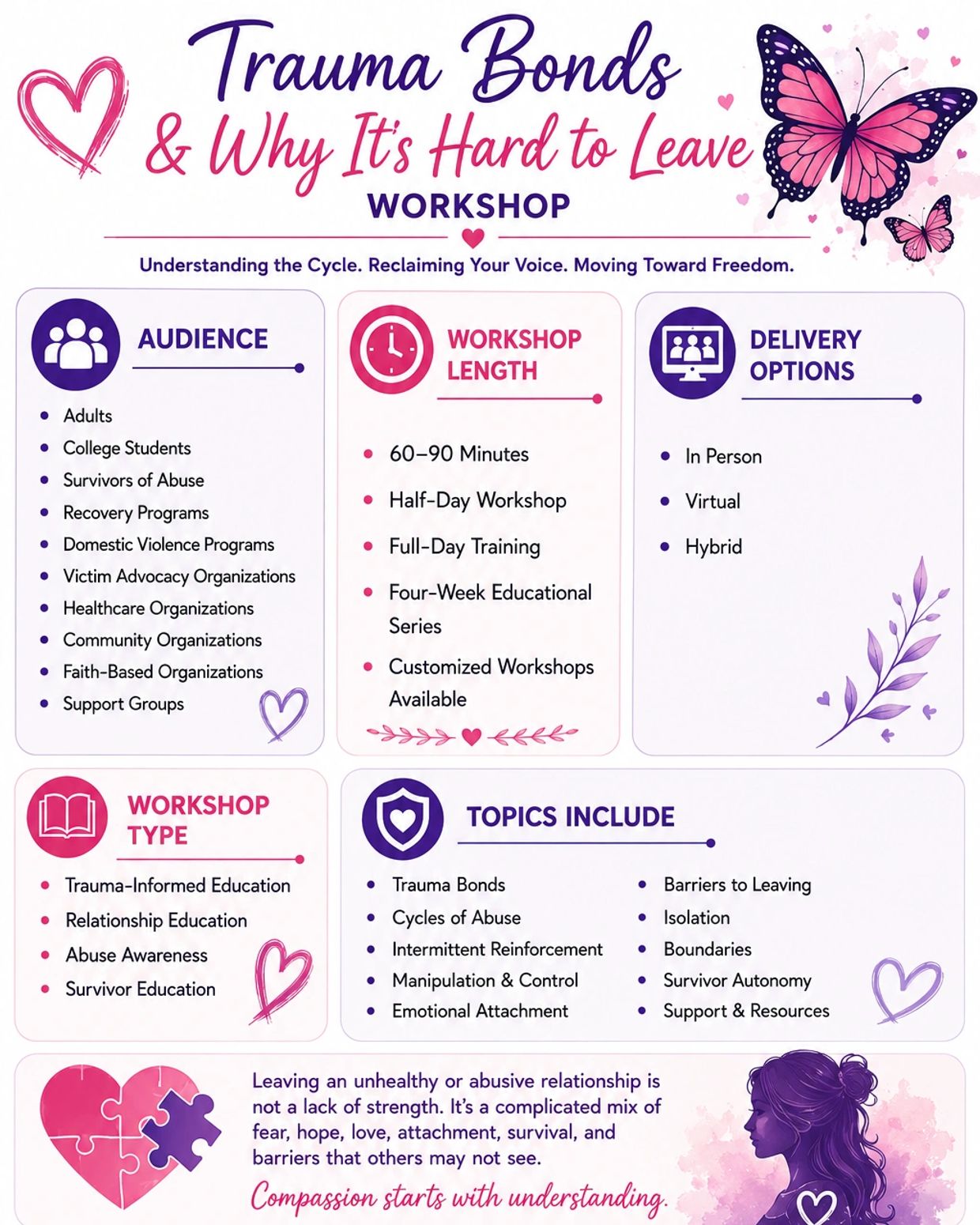
wORKSHOP Details
Workshop Overview
One of the most common questions asked about abusive or unhealthy relationships is, "Why didn't they just leave?"
That question dramatically oversimplifies what survivors may experience.
Fear, attachment, financial dependence, isolation, children, housing insecurity, threats, shame, hope for change, manipulation, emotional dependency, and concerns about safety can all influence someone's decisions. In some relationships, repeated cycles of harm followed by affection, apologies, promises, or periods of calm can make the emotional connection even more confusing.
The Trauma Bonds & Why It’s Hard to Leave Workshop helps participants better understand these complicated relationship dynamics without blaming or shaming survivors.
Through survivor-informed education, guided discussion, real-world examples, and reflective activities, participants explore how unhealthy relationship patterns develop, why they may become difficult to leave, and how boundaries, support systems, resources, and informed decision-making can support greater autonomy.
This workshop is educational and is not therapy, counseling, legal advice, or individualized safety planning. Participants who need additional assistance are encouraged to connect with appropriate professional and community resources.
This workshop can be customized for survivors, colleges, healthcare organizations, recovery programs, victim advocacy organizations, domestic violence programs, nonprofits, community organizations, faith-based organizations, and professional audiences.
Learning Objectives
Participants will learn how to:
- Understand what the term trauma bond means.
- Recognize common cycles in unhealthy or abusive relationships.
- Understand intermittent reinforcement.
- Recognize manipulation and controlling behaviors.
- Explore how attachment can exist alongside harm.
- Understand why leaving may be complicated.
- Recognize emotional and practical barriers to leaving.
- Understand the impact of isolation.
- Recognize patterns of blame, guilt, and shame.
- Understand the role of hope and promises of change.
- Develop greater awareness of healthy boundaries.
- Understand the importance of survivor autonomy.
- Identify healthy support systems.
- Learn when and where additional professional support may be appropriate.
Duration & Delivery Options
We understand that education about trauma bonds and abusive relationship dynamics requires sensitivity, flexibility, and careful consideration of the audience. The Trauma Bonds & Why It’s Hard to Leave Workshop can be customized based on your organization, participants, available time, and educational goals.
One-Hour Presentation
Perfect for colleges, community organizations, awareness events, recovery programs, healthcare organizations, advocacy groups, and professional audiences. Participants receive an introduction to trauma bonds, cycles of abuse, manipulation, intermittent reinforcement, barriers to leaving, and survivor-centered support.
Half-Day Workshop (2–4 Hours)
A more interactive experience that allows participants to explore trauma bonds, attachment, cycles of abuse, manipulation, isolation, boundaries, barriers to leaving, and survivor autonomy through guided discussions, scenarios, reflection activities, and educational exercises.
Full-Day Training
Designed for organizations seeking a more comprehensive understanding of unhealthy and abusive relationship dynamics. Participants explore trauma bonds, coercive and controlling behaviors, attachment, intermittent reinforcement, emotional dependency, practical barriers, survivor autonomy, support strategies, and community resources.
Four-Week Educational Series
The multi-session format allows participants to explore these concepts gradually while developing greater awareness of relationship patterns, boundaries, self-worth, support systems, and personal autonomy.
Customized Programs
Content can be customized for survivor-serving organizations, healthcare professionals, recovery programs, colleges, nonprofits, faith communities, community groups, and other audiences. Language, examples, activities, and educational depth can be adapted appropriately.
Available Delivery Formats
- In-Person Workshops
- Virtual Workshops
- Hybrid Events
- College & University Programs
- Survivor Education Programs
- Recovery Program Workshops
- Professional Education
- Conference Sessions
- Community Education Events
- Support Group Workshops
Why This Workshop Matters
People experiencing unhealthy or abusive relationships are often judged for decisions outsiders may not understand.
Questions such as "Why did you stay?", "Why did you go back?", or "Why didn't you see the signs?" can place responsibility on the person experiencing harm rather than helping others understand the complex dynamics involved.
The reality can be much more complicated.
Someone can recognize that a relationship is hurting them while still loving the person. They may remember periods when the relationship felt safe and hopeful. They may have children, shared finances, limited housing options, fears about retaliation, or little outside support.
Manipulation, isolation, repeated promises of change, and cycles between distress and affection can add another layer of confusion.
Understanding these dynamics can replace judgment with knowledge.
For survivors, education can also provide language for experiences that previously felt impossible to explain.
At The Jane Doe Foundation, we believe people deserve education that respects their experiences and their autonomy. The goal is not to tell someone what decision they must make. It is to provide information, resources, and support that can help them better understand their circumstances and available options.
Understanding why leaving can be difficult is one step toward replacing judgment with compassion.
Topics Covered
Understanding Trauma Bonds
Explore what trauma bonding means and how powerful emotional attachments can develop within relationships that also involve periods of harm, fear, or instability.
The Cycle of Abuse
Learn how recurring patterns of tension, harmful behavior, reconciliation, promises, affection, and periods of calm can affect how someone experiences a relationship.
Intermittent Reinforcement
Understand how unpredictable periods of affection, attention, apologies, or positive experiences can strengthen attachment and hope for change.
Manipulation & Control
Recognize behaviors involving guilt, pressure, blame, intimidation, monitoring, isolation, coercion, or attempts to control another person's choices.
Emotional Attachment
Explore why loving someone and recognizing that a relationship is unhealthy are not mutually exclusive experiences.
Why Leaving Can Be Difficult
Examine emotional, financial, social, logistical, family-related, and safety-related barriers that may influence someone's ability or readiness to leave.
Isolation & Dependency
Understand how reduced access to friends, family, finances, transportation, employment, or other resources can increase dependence.
Shame & Self-Blame
Explore how shame, guilt, embarrassment, and self-blame can discourage people from seeking support.
Boundaries & Autonomy
Understand the importance of personal choice, healthy boundaries, informed decision-making, and respecting survivor autonomy.
Support & Resources
Learn how supportive relationships, professional services, advocacy organizations, and community resources can help individuals explore their options.
What's included
Every Trauma Bonds & Why It’s Hard to Leave Workshop is designed to provide compassionate, survivor-informed education while respecting participants' experiences, privacy, and autonomy.
Comprehensive Curriculum
A trauma-informed educational curriculum covering trauma bonds, cycles of abuse, intermittent reinforcement, attachment, manipulation, controlling behaviors, barriers to leaving, boundaries, autonomy, and support resources.
Educational Handouts
Participants may receive relationship-pattern worksheets, trauma bond education, boundary resources, red-flag guides, reflection activities, support information, and community resource materials.
Interactive Learning Activities
Participants engage with educational scenarios, pattern-recognition exercises, guided reflection, and activities designed to strengthen understanding without requiring personal disclosure.
Guided Discussion
Facilitated conversations provide opportunities to explore relationship dynamics while maintaining a respectful environment that avoids blaming or pressuring survivors.
Question & Answer Session
Dedicated time allows participants to ask questions and clarify concepts related to trauma bonds, relationship patterns, barriers to leaving, and available support.
Certificate of Participation (Available Upon Request)
Organizations may request Certificates of Participation for attendees completing the workshop or educational series.
Community Resources
Participants receive information about relevant Ohio and national domestic violence, sexual assault, victim advocacy, mental health, crisis, legal, housing, and community support resources.
Follow-Up Materials
Organizations may receive additional educational materials, reflection exercises, relationship resources, articles, and information supporting continued learning.
Workshop Customization
Content can be adapted based on your audience, organizational setting, available time, and educational objectives.
Included With Every Workshop
- Professionally developed trauma-informed curriculum
- Survivor-informed educational content
- Interactive learning activities
- Relationship-pattern education
- Boundary and autonomy resources
- Guided discussions
- Question & Answer session
- Community resource information
- Follow-up educational materials
- Optional Certificates of Participation
- Customized content for your audience
- Respectful, nonjudgmental educational approach
Ready to bring this workshop to your organization or community?
If you'd like to bring the Trauma Bonds & Why It’s Hard to Leave Workshop to your organization, college, recovery program, advocacy program, healthcare setting, or community, we'd love to work with you.
Complete the request form below, and we'll contact you to discuss your population, goals, scheduling, and customization options.
In a crisis? Check out these resources!
Visit our Services Page, browse our Programs and Workshops, read our Articles, listen to our Podcast, or learn how to Volunteer.
Serving Communities Throughout Ohio
Copyright © 2026 The Jane Doe Foundation - All Rights Reserved.
EIN 41-5375467 Donations are tax-deductible
This website uses cookies.
We use cookies to analyze website traffic and optimize your website experience. By accepting our use of cookies, your data will be aggregated with all other user data.