ESTABLISHED 2026
Understanding Abuse & Power Dynamics Workshop
Recognizing What’s Happening. Understanding the Patterns. Empowering Informed Choices.
Abuse is not always physical, and unhealthy power dynamics are not always easy to recognize. The Understanding Abuse & Power Dynamics Workshop provides trauma-informed, survivor-informed education that helps participants recognize different forms of abuse, understand patterns of power and control, identify manipulation and coercive behaviors, and develop greater awareness of healthy versus unhealthy relationship dynamics.
Quick Facts
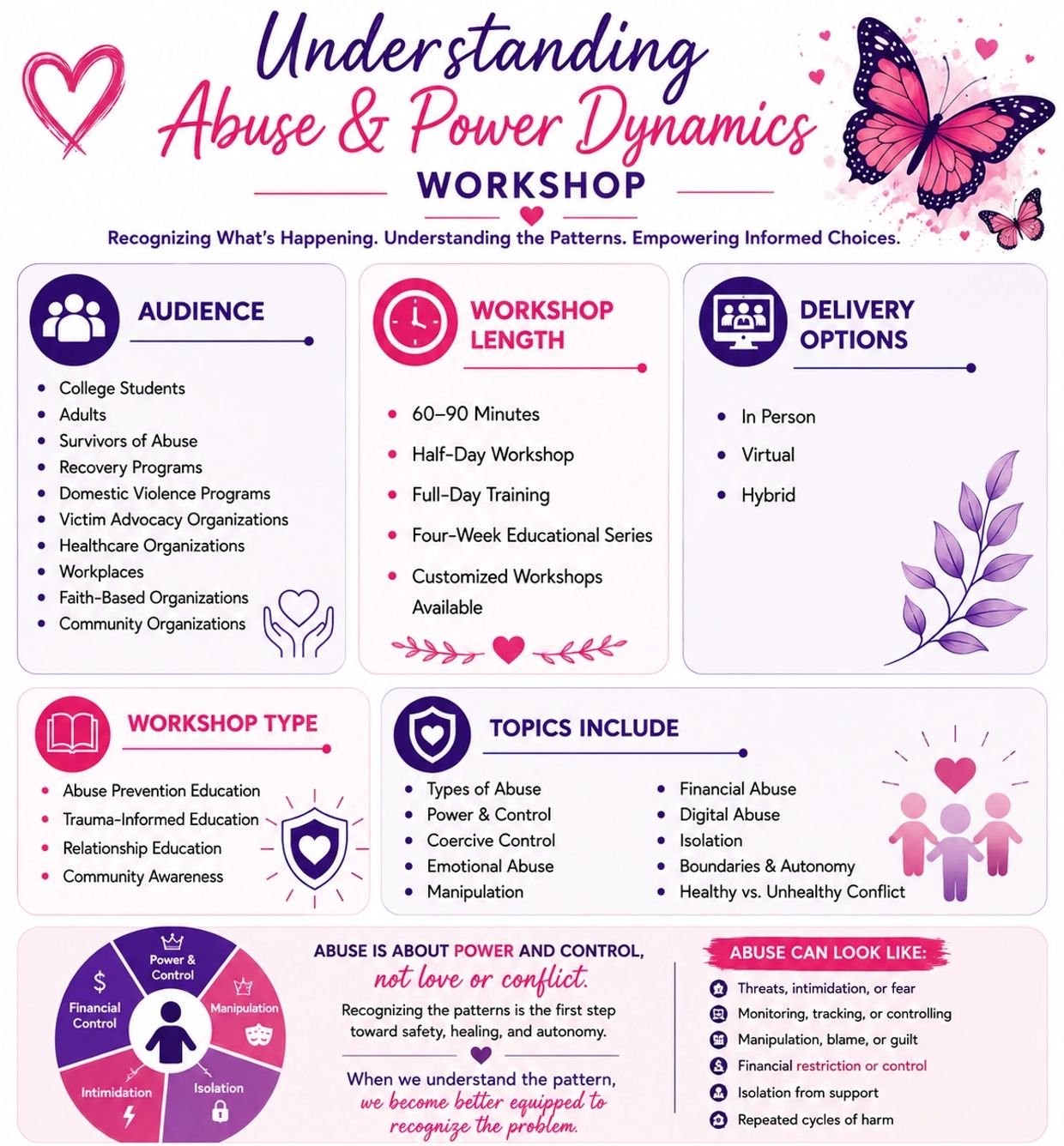
wORKSHOP Details
Workshop Overview
Abuse can take many forms. While physical violence may be easier to recognize, emotional abuse, psychological abuse, financial control, sexual coercion, intimidation, isolation, digital monitoring, threats, and manipulation can also significantly affect a person's safety, independence, and well-being.
These behaviors often do not happen all at once.
Unhealthy dynamics may develop gradually, making it difficult for someone experiencing them—or people around them—to recognize what is happening.
The Understanding Abuse & Power Dynamics Workshop helps participants examine how power and control can operate within relationships while learning to recognize behaviors that may indicate unhealthy, controlling, coercive, or abusive dynamics.
Participants explore the differences between healthy conflict and abuse, learn how manipulation and coercive control can affect decision-making and independence, and examine why abuse should be understood as a pattern of behavior rather than only isolated incidents.
Through interactive education, scenarios, guided discussion, and practical exercises, participants develop language for identifying concerning behaviors while learning about boundaries, autonomy, healthy relationships, and available support resources.
This workshop can be customized for college students, adults, survivors, healthcare organizations, recovery programs, victim advocacy organizations, domestic violence programs, workplaces, nonprofits, faith-based organizations, and community groups.
Learning Objectives
Participants will learn how to:
- Identify different forms of abuse.
- Understand power and control dynamics.
- Recognize coercive and controlling behaviors.
- Identify emotional and psychological abuse.
- Recognize financial and digital control.
- Understand manipulation and intimidation.
- Recognize isolation as a potential control tactic.
- Distinguish healthy conflict from abusive patterns.
- Understand how abuse can escalate over time.
- Recognize boundary violations.
- Understand consent and personal autonomy.
- Identify common misconceptions about abuse.
- Respond more compassionately to disclosures.
- Identify appropriate community resources and support.
Duration & Delivery Options
We understand that conversations about abuse require sensitivity, thoughtful facilitation, and content appropriate for the audience. That's why the Understanding Abuse & Power Dynamics Workshop can be customized based on your organization's needs, participant population, available time, and educational goals.
One-Hour Presentation
Perfect for colleges, workplaces, healthcare organizations, community groups, awareness events, recovery programs, and professional audiences. Participants receive an introduction to different forms of abuse, power and control, coercive behaviors, manipulation, boundaries, and recognizing unhealthy relationship dynamics.
Half-Day Workshop (2–4 Hours)
Participants explore abuse and power dynamics more deeply through scenarios, discussions, reflection exercises, and interactive activities covering emotional abuse, coercive control, manipulation, isolation, financial abuse, digital behaviors, boundaries, and personal autonomy.
Full-Day Training
Designed for organizations seeking comprehensive education on abuse and relationship dynamics. Participants examine different forms of abuse, patterns of power and control, coercive behaviors, manipulation, escalation, barriers to seeking help, survivor autonomy, trauma-informed responses, and community resources.
Four-Week Educational Series
The multi-session format allows participants to explore these concepts gradually. Sessions can examine types of abuse, power and control, manipulation, relationship patterns, boundaries, autonomy, support systems, and prevention strategies in greater depth.
Customized Programs
Content can be adapted for healthcare professionals, survivor-serving organizations, recovery programs, colleges, workplaces, nonprofits, faith communities, advocacy organizations, and other audiences. Scenarios, activities, terminology, and educational depth are tailored to the participants.
Available Delivery Formats
- In-Person Workshops
- Virtual Workshops
- Hybrid Events
- College & University Programs
- Workplace Education
- Healthcare Education
- Survivor Education Programs
- Recovery Program Workshops
- Conference Sessions
- Community Awareness Events
Why This Workshop Matters
Abuse is often misunderstood because many people associate it primarily with physical violence.
But power and control can appear in many different ways.
Someone may control another person's finances, monitor their phone, isolate them from friends and family, repeatedly humiliate them, threaten consequences, pressure them sexually, interfere with employment, restrict transportation, or gradually undermine their independence.
Individually, some behaviors may be difficult to interpret. Looking at patterns, context, power, and control can provide a clearer picture.
Understanding these dynamics is important not only for people who may experience abuse but also for friends, family members, professionals, educators, employers, and community members who may someday recognize warning signs in someone they know.
Education can help replace misconceptions and victim-blaming with understanding.
At The Jane Doe Foundation, we believe people deserve the knowledge necessary to recognize unhealthy dynamics, understand their options, respect survivor autonomy, and know where to find appropriate support.
When we understand the pattern, we become better equipped to recognize the problem.
Topics Covered
Understanding Different Types of Abuse
Explore physical, emotional, psychological, sexual, financial, digital, and other forms of abusive or controlling behavior.
Power & Control
Understand how abuse can involve patterns designed to gain or maintain power over another person's choices, independence, relationships, or daily life.
Coercive Control
Learn how repeated intimidation, isolation, monitoring, threats, restrictions, and other behaviors may be used to limit another person's autonomy.
Emotional & Psychological Abuse
Recognize humiliation, degradation, intimidation, threats, persistent criticism, blame, and other behaviors that may harm emotional well-being.
Manipulation
Explore tactics involving guilt, pressure, blame-shifting, denial, distortion, and other behaviors intended to influence another person's perceptions or choices.
Financial Abuse
Learn how money, employment, credit, accounts, property, or access to financial resources can be used as mechanisms of control.
Digital Abuse & Monitoring
Recognize concerning behaviors involving passwords, location tracking, devices, social media, repeated messaging, online harassment, and digital surveillance.
Isolation
Understand how restricting relationships, transportation, employment, activities, or access to support systems can increase dependence.
Healthy Conflict vs. Abuse
Learn the difference between ordinary disagreements and repeated patterns involving fear, intimidation, coercion, control, or harm.
Boundaries, Consent & Autonomy
Explore the importance of respecting another person's choices, limits, privacy, independence, and right to make decisions about their own life.
What's included
Every Understanding Abuse & Power Dynamics Workshop is designed to provide respectful, practical education while maintaining a survivor-centered and trauma-informed approach.
Comprehensive Curriculum
A professionally developed curriculum covering forms of abuse, power and control, coercive control, manipulation, emotional abuse, financial abuse, digital abuse, isolation, boundaries, autonomy, and healthy relationship dynamics.
Educational Handouts
Participants may receive power-and-control educational materials, abuse-awareness guides, healthy relationship comparisons, red-flag resources, boundary worksheets, reflection exercises, and community resource information.
Interactive Learning Activities
Participants work through realistic scenarios, identify behavioral patterns, compare healthy and unhealthy dynamics, and practice recognizing warning signs.
Guided Discussion
Facilitated discussions encourage learning and thoughtful conversation without requiring participants to disclose personal experiences.
Question & Answer Session
Dedicated time allows participants to ask questions and clarify concepts related to abuse, coercive control, relationship dynamics, boundaries, and available support.
Certificate of Participation (Available Upon Request)
Organizations may request Certificates of Participation for attendees completing the workshop or educational series.
Community Resources
Participants receive information about relevant Ohio and national domestic violence services, sexual assault programs, victim advocacy organizations, crisis services, counseling resources, legal assistance, and other community supports.
Follow-Up Materials
Organizations may receive additional educational resources, worksheets, articles, awareness materials, and tools that support continued learning.
Workshop Customization
Content, examples, activities, and educational depth can be customized based on your audience, organization, available time, and learning objectives.
Included With Every Workshop
- Professionally developed trauma-informed curriculum
- Survivor-informed educational approach
- Interactive presentation and activities
- Abuse-awareness educational materials
- Power-and-control education
- Healthy relationship and boundary resources
- Guided discussions
- Question & Answer session
- Community resource information
- Follow-up educational materials
- Optional Certificates of Participation
- Customized content for your audience
Ready to bring this workshop to your organization or community?
If you'd like to bring the Understanding Abuse & Power Dynamics Workshop to your organization, college, workplace, healthcare setting, recovery program, advocacy organization, or community, we'd love to work with you.
Complete the request form below, and we'll contact you to discuss your population, goals, scheduling, and customization options.
In a crisis? Check out these resources!
Visit our Services Page, browse our Programs and Workshops, read our Articles, listen to our Podcast, or learn how to Volunteer.
Serving Communities Throughout Ohio
Copyright © 2026 The Jane Doe Foundation - All Rights Reserved.
EIN 41-5375467 Donations are tax-deductible
This website uses cookies.
We use cookies to analyze website traffic and optimize your website experience. By accepting our use of cookies, your data will be aggregated with all other user data.