ESTABLISHED 2026
Understanding Trauma & Triggers Workshop
Why We React the Way We Do and How Understanding Can Help Us Move Forward.
Trauma can influence how people think, feel, respond to stress, build relationships, and experience the world around them. The Understanding Trauma & Triggers Workshop provides accessible, trauma-informed education that helps participants understand common trauma responses, recognize triggers, explore the connection between past experiences and present reactions, and develop practical strategies that support emotional wellness and resilience.
Quick Facts
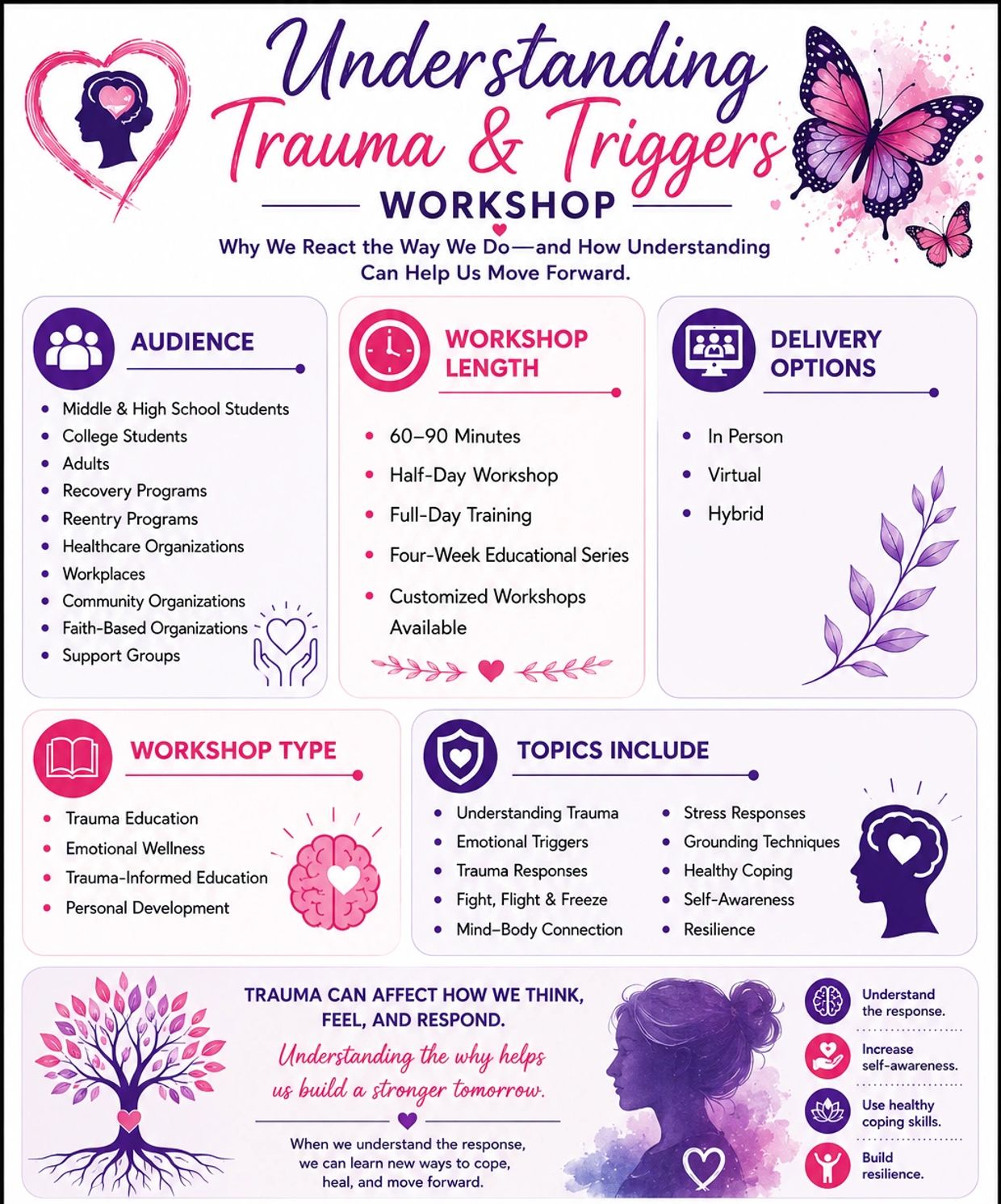
wORKSHOP Details
Workshop Overview
Trauma does not affect everyone in the same way. Two people can experience similar situations and respond very differently based on their experiences, support systems, environment, coping skills, and many other factors.
For some people, the effects of trauma may continue long after a difficult or threatening experience has ended. Certain situations, conversations, environments, sounds, smells, relationships, or memories may trigger emotional or physical reactions that seem confusing or overwhelming.
The Understanding Trauma & Triggers Workshop helps participants better understand why these responses can occur.
Through accessible education, guided discussion, real-world examples, reflection activities, and practical exercises, participants explore how stressful and traumatic experiences can affect emotions, behavior, relationships, and the body's response to perceived threats.
Participants also learn how to recognize potential triggers, identify their own stress responses, develop greater self-awareness, and explore healthy coping and grounding strategies.
The goal is not to diagnose trauma or provide therapy. Instead, this workshop provides practical education that helps participants better understand trauma-related experiences while building knowledge, compassion, and skills that support emotional wellness.
This workshop can be customized for schools, colleges, workplaces, recovery programs, reentry programs, healthcare organizations, nonprofits, community organizations, faith-based organizations, support groups, and professional audiences.
Learning Objectives
Participants will learn how to:
- Understand trauma in clear, accessible language.
- Recognize that trauma can affect people differently.
- Understand common emotional and behavioral trauma responses.
- Explore the connection between the brain, body, and stress.
- Understand what triggers are and how they may develop.
- Identify common types of triggers.
- Recognize physical and emotional signs of activation.
- Understand fight, flight, freeze, and related stress responses.
- Recognize how trauma can affect relationships and communication.
- Develop greater awareness of personal responses.
- Explore grounding and healthy coping strategies.
- Understand the importance of boundaries and support systems.
- Build practical strategies that support resilience.
- Recognize when additional professional support may be appropriate.
Duration & Delivery Options
Every audience comes to trauma education with different experiences, levels of understanding, and needs. That's why the Understanding Trauma & Triggers Workshop can be customized based on participant age, organizational setting, available time, and desired learning outcomes.
Whether you're looking for an introductory presentation or a more comprehensive educational series, we'll work with your organization to create an experience that is informative, respectful, practical, and appropriate for your audience.
One-Hour Presentation
Perfect for schools, colleges, workplaces, conferences, recovery programs, community organizations, and awareness events. Participants receive an introduction to trauma, triggers, common stress responses, the mind-body connection, and practical strategies for increasing emotional awareness.
Half-Day Workshop (2–4 Hours)
A more interactive experience that allows participants to explore trauma responses, emotional triggers, stress, grounding techniques, coping strategies, relationships, and resilience through guided discussions, reflection activities, scenarios, and practical exercises.
Full-Day Training
Designed for organizations seeking comprehensive trauma education. Participants explore how trauma can affect thoughts, emotions, behavior, relationships, and physical responses while developing practical skills involving self-awareness, grounding, coping, communication, boundaries, and resilience.
Four-Week Educational Series
The multi-session format allows participants to explore trauma education gradually while practicing new skills between sessions. Topics can include understanding trauma, recognizing triggers, stress responses, coping strategies, emotional awareness, relationships, boundaries, support systems, and resilience.
Customized Programs
Content can be customized for students, adults, employees, individuals in recovery, returning citizens, healthcare settings, nonprofits, faith communities, support groups, and other organizations. Language, examples, activities, and educational depth are adjusted for each audience.
Available Delivery Formats
- In-Person Workshops
- Virtual Workshops
- Hybrid Events
- School & College Programs
- Workplace Education
- Recovery Program Workshops
- Reentry Programs
- Healthcare & Community Education
- Conference Presentations
- Support Group Workshops
Why This Workshop Matters
Sometimes people understand what they are feeling without understanding why they are feeling it.
A conversation may cause an unexpectedly strong reaction. A particular environment may create anxiety. Conflict may lead someone to shut down, become defensive, withdraw, or feel overwhelmed.
Without understanding trauma and stress responses, these reactions can feel confusing.
Trauma education can provide context.
Learning how the brain and body respond to perceived threats can help people recognize that emotional and physical reactions often have explanations. Understanding those patterns can create opportunities to develop healthier ways of responding.
This knowledge can also help families, workplaces, schools, organizations, and communities respond to others with greater understanding.
At The Jane Doe Foundation, we believe trauma education should provide people with knowledge without defining them by what they have experienced.
Understanding the response can be the beginning of learning how to respond differently.
Topics Covered
Understanding Trauma
Explore trauma in clear, accessible language and learn why difficult or overwhelming experiences may affect people in different ways.
The Mind-Body Connection
Learn how the brain and body work together during stressful or threatening situations and why physical reactions may accompany strong emotions.
Fight, Flight, Freeze & Other Stress Responses
Understand common automatic responses that may occur when the brain perceives danger or significant stress.
Understanding Triggers
Learn how certain situations, environments, memories, conversations, sensations, or relationship dynamics may activate emotional or physical responses.
Recognizing Trigger Responses
Identify possible emotional, physical, cognitive, and behavioral signs that someone may be experiencing a strong stress response.
Trauma & Relationships
Explore how previous experiences may influence trust, communication, boundaries, conflict, attachment, and relationships.
Grounding Techniques
Learn practical strategies that can help bring attention back to the present moment during periods of heightened stress.
Healthy Coping Strategies
Explore constructive approaches for managing stress and difficult emotions while recognizing coping patterns that may create additional challenges.
Self-Awareness
Develop greater awareness of thoughts, emotions, physical sensations, behaviors, and patterns that may provide important information about personal needs.
Building Resilience
Explore how coping skills, supportive relationships, healthy routines, boundaries, self-awareness, and community resources can contribute to resilience and continued growth.
What's included
Every Understanding Trauma & Triggers Workshop is designed to provide accessible, trauma-informed education without requiring participants to disclose personal experiences.
Comprehensive Curriculum
A professionally developed, trauma-informed curriculum covering trauma, triggers, stress responses, the mind-body connection, emotional awareness, grounding, healthy coping strategies, relationships, and resilience.
Educational Handouts
Participants may receive trauma-response guides, trigger-awareness worksheets, grounding exercises, coping-skills resources, reflection activities, and additional educational materials.
Interactive Learning Activities
Participants engage through educational scenarios, self-awareness exercises, guided reflection, discussions, grounding activities, and practical skill-building exercises.
Guided Discussion
Facilitated discussions allow participants to explore trauma-related concepts and ask questions while maintaining privacy and respecting individual experiences.
Question & Answer Session
Each workshop includes dedicated time for participants to ask questions and clarify concepts related to trauma, triggers, stress responses, coping strategies, and emotional wellness.
Certificate of Participation (Available Upon Request)
Organizations may request Certificates of Participation for attendees completing the workshop or educational series.
Community Resources
Participants receive information about relevant Ohio and national mental health, recovery, victim advocacy, crisis, and community support resources.
Follow-Up Materials
Organizations may receive additional worksheets, grounding tools, coping resources, educational articles, reflection activities, and materials that reinforce continued learning.
Workshop Customization
Content, language, examples, activities, and educational depth can be customized based on your audience, organization, available time, and learning objectives.
Included With Every Workshop
- Professionally developed trauma-informed curriculum
- Interactive presentation and activities
- Trauma and trigger education
- Grounding and coping-skills resources
- Self-awareness exercises
- Guided discussions
- Question & Answer session
- Community resource information
- Follow-up educational materials
- Optional Certificates of Participation
- Customized content for your audience
- Practical strategies participants can use in everyday life
Ready to bring this workshop to your organization or community?
If you'd like to bring the Understanding Trauma & Triggers Workshop to your school, workplace, recovery program, healthcare organization, nonprofit, or community, we'd love to work with you.
Complete the request form below, and we'll contact you to discuss your population, goals, scheduling, and customization options.
In a crisis? Check out these resources!
Visit our Services Page, browse our Programs and Workshops, read our Articles, listen to our Podcast, or learn how to Volunteer.
Serving Communities Throughout Ohio
Copyright © 2026 The Jane Doe Foundation - All Rights Reserved.
EIN 41-5375467 Donations are tax-deductible
This website uses cookies.
We use cookies to analyze website traffic and optimize your website experience. By accepting our use of cookies, your data will be aggregated with all other user data.